I’ve been tracking tech shifts for years and I can tell you this: most of what you read about technology trends is noise.
You’re trying to figure out what actually matters. Which developments will change how we work and live, and which ones will fade in six months. It’s harder than it should be.
Here’s the reality: real technological change doesn’t announce itself with fireworks. It builds quietly until one day you realize everything works differently.
I spent months cutting through the hype to find what’s actually moving forward right now. Not what might happen in five years. What’s happening today.
This article shows you the technology trends today that are reshaping industries right now. I’ll walk you through what’s real and what’s just marketing.
We analyze tech developments as they happen. We test new tools, track adoption patterns, and watch how companies actually use these technologies. That’s how I separate signal from noise.
You’ll see which trends are gaining real traction, where the momentum is building, and what you should be paying attention to.
No speculation. Just what’s working now and why it matters for your decisions.
Trend 1: The AI Everywhere Ecosystem – From Generative to Autonomous
Remember when AI just meant typing prompts into ChatGPT?
That was barely two years ago.
Now we’re watching something bigger unfold. AI isn’t just answering questions anymore. It’s solving problems we couldn’t touch before.
Beyond Simple Prompts
Generative AI has moved past writing blog posts and making images. I’m talking about real work now.
Scientists are using it to model protein structures in hours instead of years. Developers feed it requirements and get production-ready code that actually works (most of the time). Engineers run simulations that used to require supercomputers.
The shift? AI went from being a writing assistant to being a research partner.
The Rise of Edge AI
Here’s where it gets interesting.
AI is leaving the cloud. It’s moving to your phone, your car, and factory sensors across the world tech togtechify landscape.
Why does this matter?
Three reasons. First, decisions happen in real time. Your phone can process what it sees without waiting for a server response. Second, your data stays on your device (which means better privacy). Third, it works when you’re offline.
A self-driving car can’t wait 200 milliseconds for cloud processing when someone steps into the road.
Multimodal AI Integration
This is where AI stops being a single-purpose tool.
Modern systems don’t just read text or analyze images. They do both at once. They listen, watch, and write simultaneously.
Picture this. A security system watches your warehouse overnight. It spots unusual movement on camera, hears glass breaking, cross-references the time with employee schedules, and writes a detailed incident report before you even wake up.
That’s not science fiction. Companies are running systems like this right now.
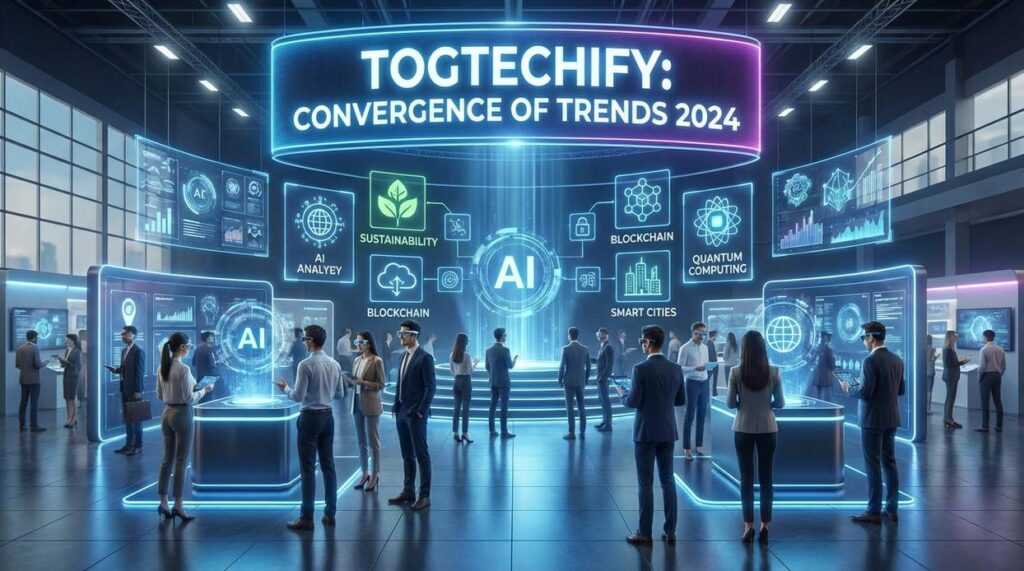
The technology trends today togtechify covers show us something clear. AI isn’t one thing anymore. It’s becoming the layer that connects everything else.
Trend 2: The Spatial Web and Immersive Realities
You’ve probably seen the VR headsets and AR demos at tech conferences.
Most of them focus on gaming or social hangouts. Fun stuff, sure. But that’s not where the real money is going.
I’m talking about what technology trends today togtechify actually covers when we look at enterprise applications. The stuff that’s changing how companies operate right now.
AR for Enterprise vs Consumer Entertainment
Here’s the split that matters.
Consumer AR gives you Pokemon in your living room. Enterprise AR puts repair instructions directly in a technician’s field of vision while they’re fixing a turbine 200 feet in the air.
One is nice to have. The other saves companies millions.
I’ve watched field service teams cut repair times by 40% using remote expert assistance through AR headsets. A senior technician in Minnesota can guide someone in Texas through a complex fix without flying out. The junior tech sees exactly what to do overlaid on the actual equipment.
Manufacturing floors are using AR overlays for quality control too. Workers spot defects faster because the system highlights problem areas in real time.
Medical training is another area where this makes sense. Surgeons practice procedures in AR before they touch a patient. The difference between this and traditional training? You can repeat the same scenario 50 times without needing a cadaver or risking anyone’s life.
VR Collaboration vs Digital Twins
Now let’s talk about VR in the workplace.
Some companies are building persistent virtual offices where global teams meet. You put on a headset and you’re in the same room as your colleagues in London and Singapore. It beats another Zoom call, but the real value is in training and onboarding (new hires can practice in virtual environments before they touch real equipment).
Then there’s the Digital Twin concept.
Think of it this way. You build a complete virtual copy of a physical system. A factory line, a power grid, an entire building. This virtual version mirrors everything happening in the real world through sensors and data feeds.
The difference between a regular 3D model and a Digital Twin? The Twin is alive. It updates constantly with real data.
Companies use these for predictive maintenance. The virtual system shows you a bearing that’ll fail in three weeks. You replace it during scheduled downtime instead of dealing with an emergency shutdown.
Process optimization works the same way. Test changes in the virtual version first. See what breaks. Fix it there before you touch the real thing.
I know some people think this is overkill. Why not just use traditional monitoring systems?
Because those systems tell you what happened. Digital Twins tell you what’s about to happen.
That’s the difference between reactive and proactive. And in industries where downtime costs six figures per hour, that difference matters.
Trend 3: The Bio-Digital Convergence
Your body is becoming programmable.
I’m not talking about some distant future. This is happening right now in labs across Minnesota and beyond.
Scientists are rewriting the code of living cells. They’re turning bacteria into tiny factories that produce materials we used to dig out of the ground or synthesize in chemical plants.
Think about it. We just watched mRNA vaccines get designed on computers, then injected into billions of arms. That’s your cells getting new instructions to build proteins they’ve never made before.
The needle prick feels the same. But what’s inside is pure information.
Some critics say we’re moving too fast. That we don’t understand the long-term effects of engineering biology at this scale. They want us to pump the brakes and study more before we deploy these technologies widely.
Fair point. But here’s what they’re missing.
People are suffering now. Someone paralyzed from a spinal injury doesn’t have another decade to wait while we debate the ethics of brain-computer interfaces.
I’ve seen footage of a man who hasn’t moved his legs in years. Electrodes rest against his skull, reading the electrical whispers of his motor cortex. He thinks about walking. The computer translates. His legs move.
The hum of processors. The soft click of actuators. The gasp when it works.
That’s not science fiction. That’s what technology trends today togtechify are delivering to real people.
We’re also growing leather without animals. Brewing fuel from engineered yeast. Building with materials that living organisms assemble atom by atom.
The line between biology and technology? It’s dissolving fast.
Trend 4: Sustainable Technology and the Green Transition
Battery tech is changing faster than most people realize.
Solid-state batteries are getting real funding now. Not the kind of money that goes to research papers. The kind that builds factories.
These batteries pack more energy into smaller spaces than lithium-ion ever could. Electric vehicles could hit 600-mile ranges (maybe more, though I’m not sure anyone’s proven that consistently yet). Grid storage becomes practical at scales we couldn’t touch before.
But here’s what I’m uncertain about.
Will solid-state batteries actually scale to mass production? The lab results look great. Manufacturing at volume is a different story. We’ve seen promising battery tech stall before.
Now look at what AI is doing for climate work.
Machine learning models can predict weather patterns weeks out with accuracy that seemed impossible five years ago. Energy grids use these predictions to balance renewable sources in real time. Wind dies down in one region? The system already rerouted power from solar farms two states over.
I’ve been following togtechify world tech news from thinksofgamers to track how what technology trends today togtechify covers align with actual funding flows. The correlation is pretty clear.
Money follows solutions that work now, not just ideas that might work later.
That said, I’ll be honest. Climate modeling still has gaps. We’re better than we were, but extreme weather events still surprise us sometimes.
The green transition isn’t just about being responsible anymore. It’s where the capital is moving.
From Trend to Transformation
We’ve covered the big shifts happening right now.
AI is everywhere. The spatial web is taking shape. Biology and technology are merging. Sustainable tech is becoming non-negotiable.
But knowing these trends exist isn’t enough. You need to understand where they’re headed and what that means for you.
That’s the real challenge.
When you focus on these core areas, you can see disruption coming. You spot opportunities others miss. You prepare instead of react.
The technology trends today togtechify covers aren’t abstract concepts. They’re forces reshaping every industry and career path.
Here’s what you do next: Look at your own field. Ask yourself how these advancements will change what you do. Then position yourself ahead of that change.
The next wave of innovation is already building. Your move is to be ready when it hits. Homepage. World Tech Togtechify.